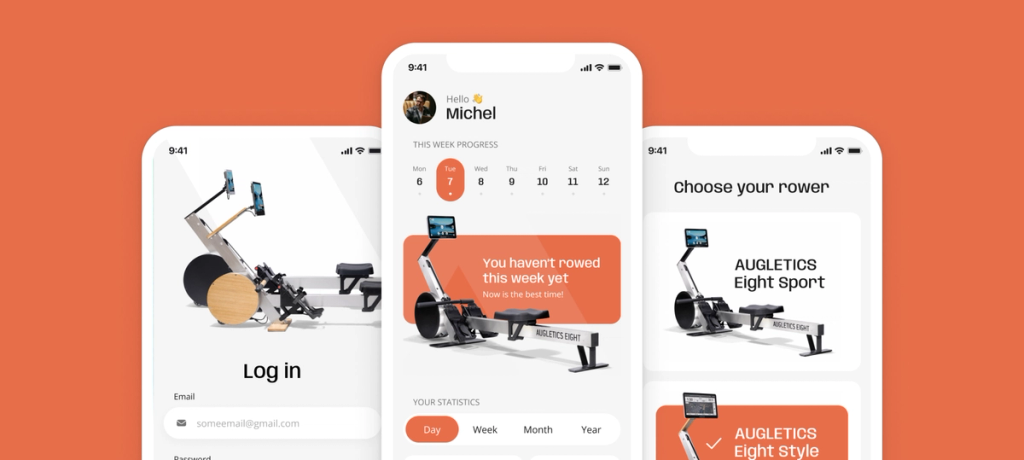
Augletics is a German company founded in 2015 that designs and builds smart rowing machines for the home. Each machine is packed with sensors and runs on an Android tablet console.
Key Insights about Augletics
Made in Germany
Augletics manufactures its machines in Königs Wusterhausen near Berlin. The company also sponsors the German women's eight.
Over 20,000 customers
According to Augletics, more than 20,000 customers train on its rowing machines.
Test winner in German press
Der Spiegel named the Eight Style its test winner in April 2025. F.A.Z. Kaufkompass picked the Eight Sport as the best magnetic rowing machine.
Year
2025
Country
Germany
Team
4 people
Development
4 months
Challenge
Stormotion built the iOS and Android companion app for Augletics, with Apple Watch heart-rate support and integrations with major fitness platforms. We also help improving the console app and the web app.
Augletics wanted to extend its rowing machines beyond the console with a companion mobile app. Users should be able to review their workouts, manage fitness integrations, and use an Apple Watch as a heart-rate sensor while rowing. The scope later grew to include the Android console app and a web app, all running on the same Firebase backend.
The main challenges were:
-
Apple Watch as a heart-rate sensor. The watch could not be connected to the console directly. The rower already maintains Bluetooth connections to several sensors, so heart-rate data had to reach the console over the internet instead. Apple tightly controls access to health data. The connection had to feel as familiar as pairing a Bluetooth sensor.
-
Evolving a product with an established user base. Augletics wanted to rethink the console experience around how people actually use it: almost entirely at home. Every change had to stay clear for current owners who already know their workflows.
-
A diverse console fleet. Machines in the field run on several console generations and Android versions. Every fix and new feature had to work across all of them without affecting existing functionality.
-
Third-party fitness integrations. Each platform has its own API, rate limits, and rules. Strava was already in use and required a migration, while Garmin only accepts workouts recorded on Garmin devices.
Process
The project started with a Discovery phase focused on what was technically possible with the Apple Watch.
The mobile app was built by a team of four: a Project Manager, a UI/UX Designer, a Developer, and a QA Engineer. We started with iOS and shared builds with the client through TestFlight, so design decisions were validated on a real phone rather than in Figma. Android followed, and both platforms were prepared for release together once the full scope and the Apple Watch integration with the console were complete.
Features were delivered in small iterations and reviewed by the client's CTO, which kept feedback cycles short. As the work expanded to the console and web apps, all three platforms were managed from a single Jira backlog.
Console development follows Augletics' own release cycle: prerelease, then beta, then production. We aligned our sprints with this cycle so our work fits the client's release schedule.
Because the product depends on physical hardware, we test on a dedicated QA device in addition to emulators.
Solution
Apple Watch heart rate via the cloud. Instead of a Bluetooth link, the mobile app triggers an Apple Health workout on the watch. Heart-rate data travels through the Firebase Realtime Database to the console, where it is displayed in real time and saved into the workout's FIT file. On the console, a connection screen guides the user step by step and shows the watch's current status.
A standardized integration layer. We designed one approach for third-party services, so each new integration follows the same template instead of being built from scratch. This keeps the codebase consistent and makes adding the next service faster. For Strava, we migrated tokens from the Realtime Database to Firestore and removed inactive users from the sync to keep usage within Strava's paid limits. Uploads run through a Cloud Tasks queue that respects rate limits, retries failed requests, and marks each workout as Queued, Uploaded, Completed, or Failed.
One backend for all platforms. The mobile app runs on the same Firebase backend and accounts as the console, so users see their workout history as soon as they sign in. Wherever the backend already provided the data, we reused it. Daily, weekly, monthly, and yearly statistics, for example, are precomputed on the server and simply pulled into the app. This shortened development and kept the logic consistent across platforms.
FIT files as the data standard. Workout data is stored in FIT files, the standard format for sports data. We build charts and workout history on top of them and add custom fields where a parameter isn't covered by the standard.
Key features of the mobile app:
-
Apple Watch heart rate shown live on the console during a workout;
-
Health and fitness integrations: Strava, Apple Health, Android Health - Connect, and Fitbit;
-
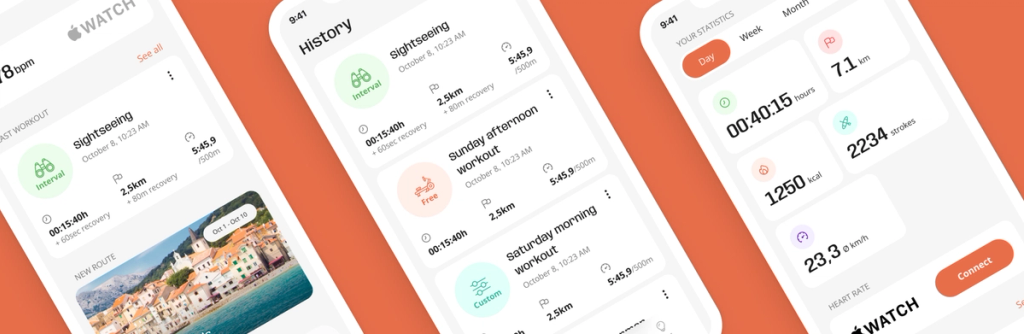
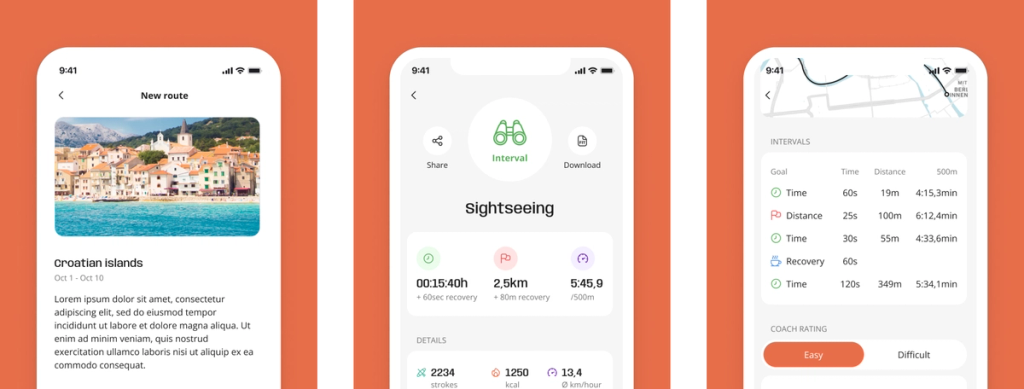
Workout history with charts for power, strokes, and heart rate;
-
Weekly calendar that opens the workout for any day you trained;
-
Statistics by day, week, month, and year;
-
Weekly route highlight published by Augletics;
-
Tips section with categorized YouTube videos;
-
Profile with photo editing and password change;
-
Rower selection for the Eight Sport and the Eight Style;
-
Four languages: English, German, French, and Italian, with a language selector;
Console app. We improved the UX of the current console within its existing design system, reusing the components already in place. In parallel, we work on heart-rate and Bluetooth connectivity, workout history, and fixes across console generations. Each workout carries a large amount of sensor data, so workout history now loads a lightweight version first and fetches the details on demand.
Web app. The web app brings the mobile app's design and functionality to the browser, with the UI adapted to larger screens.
Success for Augletics from a:
PM Perspective
The engagement grew from a mobile app to three platforms (mobile, console, and web) managed from a single backlog. Sharing iOS builds through TestFlight let the client evaluate the app on a real device during development. On the console, our work follows Augletics' prerelease, beta, and production cycle.
Development Perspective
The Apple Watch could not connect to the console directly, so we routed its heart-rate data through the cloud while keeping the connection flow simple for users. The integration template turned third-party services into a repeatable pattern. Reusing the existing Firebase backend sped up the mobile build and kept it consistent with the console.
UI/UX Perspective
We designed for three form factors: a phone, a tablet console mounted on a rower, and the web. Augletics' audience includes users aged 40+, so the mobile app is built around clear, simple flows. On the current console, we improved the UX using the existing components, and Augletics approved the updated flows.
QA Perspective
Our QA engineer works directly with the client's development team and supports deliverables on Augletics' side as well. Features are tested on real hardware, not only emulators. Integration testing covers connecting, disconnecting, re-authorization, and denied permissions.
DevOps Perspective
We set up the iOS and Android environments from scratch, including Firebase projects, App Store Connect, and Google Play internal testing. Builds and distribution run through a Fastlane-based CI/CD pipeline. Since the mobile app shares a backend with the console, backend deploys are synced with app releases.
Overall Business / Roadmap Perspective
The mobile app is live on iOS and Android. The cloud-based approach used for the Apple Watch leaves room for future wearable integrations.

















Todd Gilligan
Innovation Lead @ Force USA
"I had meetings with 30 different agencies and the team at Stormotion gave me the most confidence to go forward. With them you feel like you've got a kind, knowledgable & conscientious team behind you. So I was 100% sure that they're going to be able to deliver our project!"